


Latest National Youth Tobacco Survey Shows Decline in Usage
10 Apr, 2021According to the latest National Youth Tobacco Survey (NYTS), 1.73 million fewer middle and high school students used tobacco products in 2020 than they did in 2019. Most of the decline in usage was in the e-cigarette category, while other combustible tobacco products also saw significant decreases. Teen cigarette smoking remained consistent between the two years, as did hookah, pipe tobacco and heated tobacco use, according to the same survey.
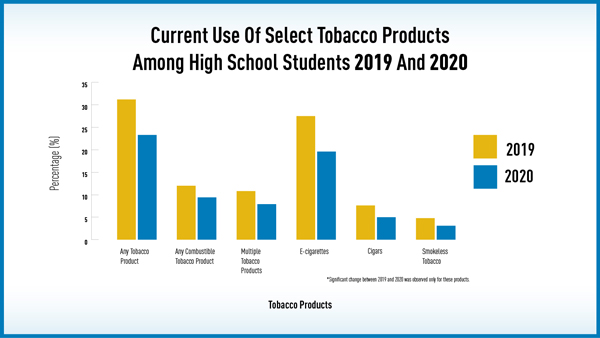
Infographic courtesy of FDA
Despite the decline in tobacco usage, the U.S. Food and Drug Administration (FDA) stated that it was still concerned about the 24 percent of high schoolers and 7 percent of middle schools that currently use tobacco products. When speaking of the survey results, the FDA re-stated its stance that e-cigarettes remain a public health issue that impacts youth, families and communities, a sentiment the agency has held for some time and used to set its focus in terms of regulations and enforcement in recent years.
The FDA highlighted several findings when reviewing the survey’s results it relates to e-cigarettes. First, the FDA attributes the regular use of e-cigarettes among teens to a dependency on nicotine. According to the results of the survey, 40 percent of high school e-cigarette users used e-cigarettes 20 or more days out of the month, with a quarter of them using e-cigarettes ever day. Middle schoolers were found to have used e-cigarettes 20 or more days in a month, with 10 percent of them using daily. Also, flavors played a role in the e-cigarette appeal among youth with 8 out of 10 current youth e-cigarette users stating that they used flavored e-cigarettes. The most common flavors used among high school students were fruit (73 percent), month (56 percent), menthol (37 percent), and candy (23 percent).
Looking ahead, the FDA is evaluating all premarket tobacco applications (PMTAs) that it received by the Sept. 9, 2020 deadline as it determines which e-cigarette products should remain on the market.
“FDA will only authorize these e-cigarette products if the science proves that, for example, their marketing is appropriate for the protection of public health. FDA will also continue to enforce the new minimum age of 21 to purchase tobacco products. In addition, while most of these FDA activities are aimed at curbing youth e-cigarette use, FDA will continue to consider and take appropriate actions based on the latest findings about youth use of all tobacco products,” the agency stated in its review of the NYTS survey results.
Reference: https://tobaccobusiness.com/latest-national-youth-tobacco-survey-shows-decline-in-usage/2/
Image retrieved from Unsplash.
stay updated
READ ALSO

Functional energy beverages are transforming the global drink industry. Discover how KRATOS Energy Drink represents the next generation of modern performance beverages.

Discover how nicotine pouches are made, from scientific formulation and ingredient engineering to precision manufacturing and quality control, and how modern oral nicotine products are transforming the smoke-free alternatives industry.

As the global nicotine market continues shifting toward smoke-free alternatives, new challenger brands are emerging. This article explores how KRATOS, developed by Tobacco International Inc., is positioning itself as a performance-driven platform within the rapidly growing oral nicotine pouch category.